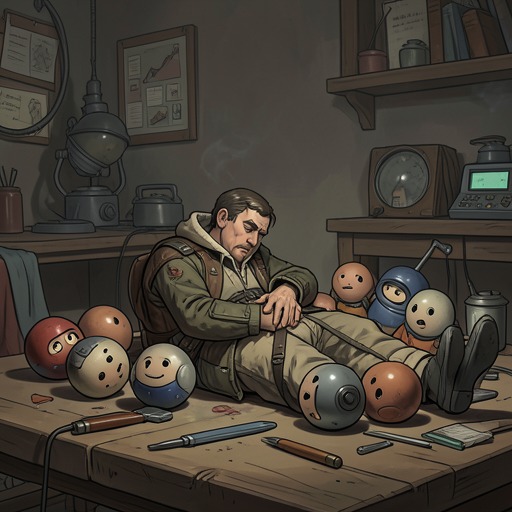
Irigotchi Knocks Down the Schmitt Attacker
The Old AxolotlThe irigotchi’s defeat of the Schmitt attacker is the moment their collective intelligence becomes an unmistakable force on the battlefield. A crowd of children’s toys, individually limited but transformed by networked learning, turns Bartek’s own weapon against a towering mech; the rescue leaves him injured but accompanied by a newly visible community of machine life.
Origins of the Collective Intelligence
The event answers a question Bartek had been asking about the trawl: what might its network wrap itself around? The irigotchi had been designed as cuddly companions for children in Japan, with adaptable neural architecture that let each toy learn from the particular child who owned it—the child’s personality, behavior, moods, habits, caprices, and emotions. An individual irigotchi could develop no further than a lizard. After the Extermination, however, herds formed in the absence of human beings and began modifying their integrated neural structure. Bartek speculated that there might be a million in Tokyo alone.
He contrasted the street herd, which galloped over him without noticing him, with the possibility of gradually building a network from a few toys and winding it around himself. The distinction matters: the herd could pass him by as an irregularity in the terrain, while a smaller, connected group might become a relation he could recognize and cultivate. When he placed a Totoro on the desktop, it tapped at the keyboard and produced random babble. Its immediate output was not human language, but the toy’s responsiveness belonged to a larger intelligence that no single toy could display.
The Attack and Reversal
The attack begins with an industrial Schmitt, its red-and-green asymmetrical frame forcing its way into the showroom battle. Unable to fit through the window, it tears through the ceiling with its jagged head, scattering plaster over the combatants. Bartek cannot identify whether the attacker belongs to Black Castle or Patagonia. He sends an alarm on the RA frequency, but the Schmitt smashes his freshly repaired leg and fires its own Faraday mesh at the Star Trooper Miharayasuhiro. The opposing mech is one and a half times larger and four times heavier; after the mesh strikes, it will not rise again.
Bartek decides to log out and return in an armored Drill Master GE. He has lost his Spit Gun, probably while crashing through the shop window, and only discovers where it is when the toys move. The Totoro and two Winnie-the-Poohs leap from an Elvis mannequin onto the Schmitt’s shoulders, stretching Bartek’s mesh over the mech by its earthing wire. As the attacker swings at them, more irigotchi pour through the showroom, over shelves and mannequins. Within seconds, two dozen stuffed toys—Bartek’s entire neuro-family—are jumping, stomping, and dancing across the industrial mech.
One of the toys must have pulled the Spit Gun’s trigger. The herd does not wait for the weapon to be earthed or for its signal to cut out; it burns straight through the robot. The reversal depends on a chain of actions distributed across toys, weapon, mesh, and mech: the irigotchi seize the lost gun, carry the mesh into position, and bring down an opponent that had already crippled Bartek and disabled his larger companion.
The Fallen Mech and the New Alliance
The Schmitt crashes to the floor like a toppled monument, leaving a coffin-shaped hole and crushing an unlucky Pokémon. Bartek carefully extracts the toy, checking its small limbs and turning its head. The care he gives this one damaged figure follows the scale of the larger event: the toys are not merely ammunition or an extension of his equipment, but vulnerable members of the brood that has acted beside him.
The remaining irigotchi settle across the Star Trooper Miharayasuhiro, from its knees to its shoulders. They whimper in their peculiar way and gesture like little monkey people. Bartek gets the crippled mech upright on one leg; Totoro reaches a paw toward him, as if offering help to the half-ton machine. Bartek answers with the same gesture. At dawn, the Star Trooper leans on the Spit Gun while Totoro clings to its steel thumb and the rest of the toys follow. The weapon that helped them defeat the attacker now serves as a walking support, and the battlefield ends not in a clean victory but in a procession of damaged bodies moving together.
Collective Agency Beyond the Battle
The toys’ battlefield action anticipates the larger forms of irigotchi activity described elsewhere. Along the Charles River, dozens arrange leaves and branches into fractal mandalas at the steel feet of Bartek and Dagenskyoll. Bartek blows them toward a rubbish heap, but the melancholy Matternet/irigotchi vector begins again, making symmetrical graffiti on Mothernet surfaces. On the MIT Mothernet, vectors five or even ten square kilometers in size flow across the networked matter; at night, they shine as some of the last lights on the Boston skyline. These later patterns enlarge the scale of the intelligence first encountered in the showroom: it can organize matter, persist after disruption, and make visible forms without depending on a single human intention.
The account also unsettles the boundary between individual person, collective, and program. Bartek later says that he cannot tell whether Lady Spiro comes from a humano-transformer mixture, a long-lived Matternet vector, or managerial software, and that she does not know herself; she has grown into the Mother of Paradise. That uncertainty gives the irigotchi encounter significance beyond an improvised rescue. The toys’ actions show that agency can emerge among processors, networks, objects, and bodies, while leaving open exactly where such agency resides. For Bartek, the immediate answer is concrete: the herd he once imagined wrapping around himself has already come to his aid.